
#SMB Broker Insights 101.01
Hi friend,
Happy New Year! Let’s grow together this year. To get the momentum started, here is the first edition in a series of stories about SMB deals. My goal is to demystify the industry and share insights that help you close deals. Let’s get started!
Don’t forget about the lease.
In SMB deals the lease can be a deal killer – here’s a learning nugget I acquired and how it can help you close a deal.
Deal Breakdown:
Industry: Dog grooming – a robust industry coming out of the ‘dog-boom’ from covid pandemic lockdown period
Asking Price: $168,000
Annual revenue: ~$220,000
Annual EBITDA: $81,000
Reason for Selling: Owner moving away with family
Lease term: expiring within 6 months – opportunity for buyer to negotiate new terms
The listing attracted multiple buyers, including a wealthy international buyer, paying all cash, who was looking to expand the business through investment in multiple full-service vans adding mobile service to the menu offerings. The seller was of Chinese heritage, and the buyer a wealthy Chinese businessman looking to buy a business for his son to operate.
The business was situated in a standard strip shopping center in the Bay Area of California. It was a commercially zoned property, owned by a large conglomerate and managed by a large-scale professional property management company.
One of the key issues that needs to be balanced in any SMB deal is “When and how the seller should engage with the landlord?”
In this case the Seller had what they thought was a good relationship with the landlord. The Dog Grooming business was one of the reliable, successful tenants in the shopping strip, aside from the anchor tenant grocery store and a chain pizza parlor.
The landlord was planning a renovation of that side of the building, including the Dog Grooming business unit, and therefore had agreed to re-locate it to another, larger unit, with approximately 50% more square feet of usable space. However, this unit did not have the plumbing hookups required for the bath and washing stations. The landlord agreed verbally to pay for the buildout at no cost to the tenant.
As negotiations proceeded between the buyer and seller in Chinese, I was stuck as the odd man out, as I could not even understand what was being communicated between my client and the prospective buyer.
Nonetheless, we entered contract and proceeded to the lease assignment stage, when the Landlord changed tune, pulling a bait-and-switch, after taking 3 weeks to reply to an email about the buyer’s application, the landlord now required the tenant to pay for 100% of the cost of the plumbing renovations and build-out.
Naturally this spooked the buyer and the deal fell apart.
The #learningnugget here is that the Landlord is a critical stakeholder in #SMB deals. Make sure to gather all details about lease terms and lease assignment notification periods up front during seller due diligence. The Landlord cited a single clause buried in the terms that stated any intention of lease assignment must be disclosed with 60 days advanced notice. Rather than negotiate in good faith the landlord used this scare away the buyer and the deal fell apart.
Effectively Managing “Triple Bottom Lines”
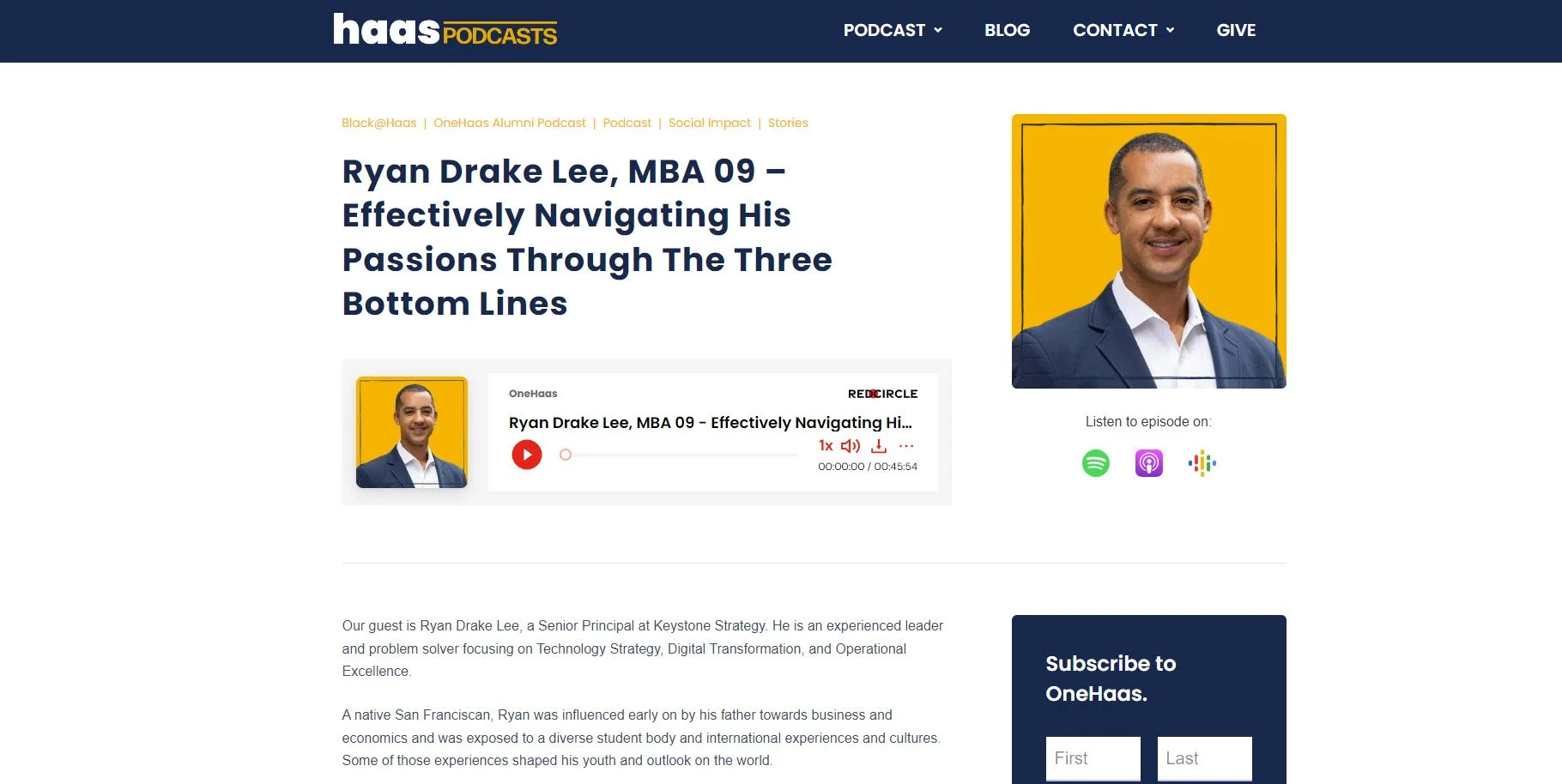
Sharing a podcast I did with Haas Podcasts as Haas Berkeley Alum class of 2009, and the blog post about it…
“Our guest is Ryan Drake Lee, a Senior Principal at Keystone Strategy. He is an experienced leader and problem solver focusing on Technology Strategy, Digital Transformation, and Operational Excellence.
A native San Franciscan, Ryan was influenced early on by his father towards business and economics and was exposed to a diverse student body and international experiences and cultures. Some of those experiences shaped his youth and outlook on the world.
In this episode, Ryan shares what it was like going to one of the most prestigious historically Black colleges, why he pursued an MBA, and his extensive professional career.
Ryan also talks about his passion for environmental sustainability, climate change, and social justice and how those areas of interest have come into play with what he is currently doing at Keystone Strategy.
Episode Quotes:
On the role of Historically Black Colleges and Universities (HBCUs) in the lives of Black Americans
“I think HBCU has played a pivotal role in the landscape of academic institutions and what they provide to different populations of people, that intense focus on the Black American experience, and refining their academic and campus life, programs, and how they create opportunities and make partnerships with businesses for employment and others institutions for cross-disciplinary learning, and how they’re trying to create different channels and pipelines to getting access to diverse talent, specifically black Americans. So, I think the role that HBCUs play is immensely important and I’m happy and privileged to have been a part of it.”
On pursuing an MBA even when he already had a successful professional career
“What I observed as a young professional joining McKinsey was pretty much almost a formula. And the formula was, do a few years as an analyst, go to a prestigious graduate program, right? Probably an MBA, maybe a public policy degree program or a law degree, and essentially, come back to McKinsey, and in a few years, you’ll be a partner and you’ll essentially be rich and be able to ride off into the sunset. I know now that life is not that simple and lots of things have changed, but quite frankly, I was convinced that was the formula and the path to success or at least part of what I aspire to have in terms of a career. The way people would look up to partners and admire their ideas and the power that they had and how people would automatically be quiet as soon as they spoke – that looked attractive to me. I also knew that as I was leaving my analyst time after two years at McKinsey, I felt like I would have been in the ivory tower. I’m pushing paper, I’m making slides and Excel. And it was like, let me go see what it’s like, you know, get your hands dirty at the ground level. Which is what drew me to be a volunteer consultant at TechnoServe and go work at the ground level, literally, in developing countries. I really enjoyed that but then also, let’s be honest. I wanted to have a good living and make a good living and earn some money. So, it was clear that I wanted to go get an MBA.”
Thoughts on climate change
“From an economic standpoint, I feel like climate change is really a resource allocation challenge, right? We’re not allocating the right resources to the right technologies. We have solutions to lots of the polluting challenges that we have. They’re just not economic enough to deploy at scale. So, it’s an economic challenge to solve many of the challenges and problems we face.”
On managing his professional career and tying it with the things he is passionate about
“What comes to mind for me is, I continue to think of the double and triple bottom lines. I learned about that at Haas. First bottom line being your business bottom line, right? What’s your dollar profit? Your second bottom line being your kind of social impact, right? What is the impact of the business that you do in the communities where you do it? And then your third bottom line is around the environment, right? What is the impact to the environment? I often think about how can we try to aspire to more of this circular loop economy where we don’t have this linear economy where you kind of extract natural resources out of the ground, turn them into something consumable, that is then consumed and then sits in a landfill forever. How do we make this more of a circular loop so that things are sustainable perpetually?”
Show Links:
Who wants to be an Economist when they grow up?
In the 10th grade, I took my first economics course. My teacher was named Bruno Barros. He was a short man with brown hair and wore actual sweater vests. He had a very matter-of-fact and straight way of communicating.
Bruno introduced me to the topics of micro and macro economics. He brought copies of The Economist magazine to class and assigned us articles to read. I loved every word. To me, it explained how money works, how governments are funded, essentially how capitalism plays out day to day and our societies are structured. I also looked at the job advertisements in the back. I saw roles with titles like United Nations Economic Development Programme Comptroller, United States Treasury Economic Analyst, or French Ministry of Commerce Finance Director. I aspired to earn one of those roles and to influence how global finance worked for all people, especially historically marginalized communities of color….a future Business Economist was formed in the classroom lectures of Mr Barros in the late 1990s. That future Business Economist is me today!
Let my passion for business economics and strategy help your business grow. Reach out today.
The First Triple Play Bundle
Let me tell you a Sales & Marketing story about when I was on the team that came up with the first Triple Play Bundle in Telecommunications products.
In 2004, Bell South was fiercely competing in the US telecommunications markets offering residential and business telephone services plans, internet service plans, cable TV service plans, as well as cellular mobile phone service plans. (Bell South was acquired by AT&T in 2006)
Service providers competed intensely for market-share of the ~100M US Households already virtually ~95% saturated for telephone and cable TV service, but lots of headroom upside for mobile phone and internet market penetration for ‘customer share of wallet’.
This was still the pre-smartphone era, so Nokia, Motorola, Sony, Ericsson and increasingly, Samsung and RIM’s Blackberry were the dominant and emerging brands. Mobile phone capabilities were limited to local, national, and int’l calling. Voicemail, ring-tones, and music were very limited, and considered luxury services.
Competition was cut-throat and service plans were generally sold in annual contracts or pre-paid minutes, which were costly, but the best option for many customers who could not afford an annual contract commitment, or who didn’t qualify due to credit requirements.
There was a lot of customer switching between service providers, what the industry measures as ‘customer churn’, causing service providers to spend heavily trying to establish customer loyalty.
A key Operating financial fact was that while Bell South owned copper telephone cables, it did not own any cellular network and had limited TV cable network infrastructure. This meant that the marginal cost of serving one incremental telephone customer was ~$0, while the marginal cost of serving one additional cellular or cable TV customer came with measurable marginal cost.
Nonetheless, my hypothesis was that cellular phone and cable TV customers were much more loyal, or ‘sticky’ to use the industry jargon, and generated more profit.
Problem Statement: What is the total profit of each customer type, based on which products they purchase and how long they remain a subscriber of each individual product?
I didn’t know it at that time, but I was pioneering the early marketing analyses that would become known as ‘Customer Lifetime Value’ or “CLTV”.
I requested access to all customer data across the entire Bell South customer base for a period of 5 years, and requested that data to include columns indicating which customers subscribed to which products for each monthly billing cycle.
I could now see which customers stayed with Bell South the longest number of billing cycles, and which products those customers subscribe to, then compare them against one another in any combination of ways using tables and spreadsheets.
I created pivot tables and used vlookup formulas to structure and organize the customer data into clusters and archetypes of similar profiles. When telling business stories, it always helps to humanize the data by providing sample customer profiles with specific attributes and consumer behaviors personified with a name.
‘Darlene, Head of Household, earning 15% above the local area median HH income with two children and one elderly family member. Telephone usage habits include: heavy local calling, some long-distance calls, but strong emerging demand for internet service as children require internet access for school.
Darlene is a strong candidate for a bundled offer that includes 1. Phone service, 2. Internet service, and 3. Cable TV service, if offered for a good deal. The CLTV analysis enabled me to determine the $ value that could be offered as a sign-up promotion, e..g., Triple Play bundle for 2-year commitment with $200 cash back or rebate.
I pitched the Darlene profile promotion to the CMO and his staff and they greenlighted a large pilot. It was the first time that Bell South was offering service plan promotions >$50, let alone $200. I created the promotion offerings based on the CLTV analysis that I had completed.
I shared those promotion parameters with the marketing team and a couple weeks later the first promotional offers were going out by snail mail and being pitched to customers who contacted the customer service hotline.
It was the first time my work had actually touched a customer and impacted a Fortune 500 company’s operations. I had tasted the impact of hypothesis-driven, data analysis, insights generation and customer-centric storytelling.
The learnings from that client engagement stick with me even today.
A deep understanding of consumer behavior, coupled with hypothesis driven deep data analysis, can reveal worthwhile offerings that customers demand.
Concise and personable storytelling can influence senior management and get your ideas implemented on the front lines.
Whether it’s a Triple Play Bundle, or a new product/service offering in your market segment, deep customer insights and hypothesis-driven experiments can drive growth.
Let my passion and experience for Sales & Marketing help your business grow. Reach out today.
Payless Shoesource Strategy & Operations Case Study
Let me tell you a Strat/Ops story about when I transformed Payless Shoesource’s store operating model.
In 2005, Payless Shoesource (PSS) was facing declining same store sales, and declining customer satisfaction scores. At the time Payless sold one in four pairs of shoes in the US. An incredible achievement in terms of operational footprint and market coverage.
A good comparison is the great American brand, The Coca-Cola Company, whose operational footprint goal of being available for sale at literally every point-of-sale (POS) where beverages are sold globally, is an operational distribution masterclass.
The complication was that PSS operated a network of >5,000 stores across the US, Canada and Mexico, employing over 30,000 people. The problem would not be easy to solve and the impact of my recommendations would impact that large and diverse frontline employee workforce who perform the physical labor each day.
Store operations of this scale include complexities such as full-time vs. part-time employees and scheduling, recruiting at scale, hiring and training at scale, management hierarchy leadership and communication at scale, compliance and execution.
For example, if you change a policy, how do you get 30,000 front-line, hourly employees to execute precisely and consistently
All of the above only applies to the frontline employee store operations, we didn’t even include the supply chain in our problem scope.
Problem Statement: How can PSS increase same-store sales without increasing labor cost, thus improving same-store profitability?
We broke up the problem into two sub question workstreams:
1). How can we save store Associate time?
2). How can we best re-deploy store Associate time to increase sales?
I owned workstream #2 and got to work intensely studying the Customer Journey (CJ) through the store. I spent 60 days traveling across the network including Dallas/Ft. Worth, Atlanta, Chicago, Ft. Lauderdale/Miami, & Rancho Cucamonga, CA, observing customer journeys with a clipboard and stopwatch.
I made spaghetti diagrams of customer journeys through the store. I analyzed and categorized customer journeys into the 4 archetypes of shoppers that I concluded. I synthesized those archetypal behaviors into characteristics that store Associates could identify and then apply specific techniques, or ‘plays’ when approaching customers.
The key insight for sales conversion was to get the customer to touch the shoe with their hands and try it on. Observation concluded that when a shopper picked up a shoe and tried it on, they were 7x more likely to make a purchase. Those insights were turned into sample scripts and gestures to encourage shoppers to pick up and try on a shoe. I made playbooks for each archetype of shopper.
The next piece of the problem was to solve how to communicate these new playbooks and store operating models to a network of >5,000 stores and 30,000 frontline hourly employees.
I had to consider many variables within the problem, the role & responsibilities of Regional Managers, District Managers, Store Managers, Store Associates, hourly employees, full-time employees, and the variations in labor laws and scheduling across 50 states, cash management and security, receiving shipment and conducting inventory in the backroom.
I came up with a cascading comms plan across 5 layers of hierarchy for ~25,000 employees. I developed the training material using powerpoint to make diagrams of store layouts and draft the plays and scripts that frontline employees would run.
I created the store Operating Model and developed the training material for Store Mgrs and District Mgrs and how it would be rolled out. I had my ppt slides printed and laminated at Kinko’s printshop. I led Train-the-Trainer sessions in 3 US states, guiding people twice my age on how to more efficiently and effectively operate their stores based on 6 months of intense observational study.
In the end, I presented my recommendations to the CEO, COO, CMO and various SVPs of Operations and Finance. My recommendations would impact every store in PSS’ operating footprint with implications for all frontline employee roles and financial impact for a Fortune 500 company.
I was 23 years old at the time.
I don’t just call myself a business strategy and operations expert because it sounds official. I earned that description from on the ground operating experience like this.
Let me leverage that experience and learning to help your business grow. Reach out today.
Southwest Airlines Strategy & Operations Case Study
Let me tell you a Strat/Ops story about how I refined Southwest Airlines’ famous ‘open seating’ boarding process.
In 2006, Southwest Airlines (SWA) was experiencing severely declining customer satisfaction scores. The C-suits’s hypothesis was that the open seating policy, and its associated first-come-first-served seat selection process, was the root of the problem. The obvious solution would be to switch the open seating policy to assigned seats, chosen at the time of purchase, like how all other competing airlines operate.
The complication was that SWA enjoyed key operating advantages that resulted in economic advantages from its open-seating strategy. Airlines only make money when aircraft are in the air, not on the ground. The airline industry uses ‘turn-time’, the amount of time an aircraft spends on the ground in between flights, to measure this operational fact.
SWA had the lowest industry turn-time, 25 minutes, compared to the industry average of 75 minutes, a whopping 50 minute advantage. SWA was able to achieve this because of the open seating policy + accompanying passenger (pax) behavior which incentivized efficient seat selection and staying put.
SWA’s open-seating policy created an operational advantage because pax on SWA are trained to move and behave more efficiently than pax on competing airlines. I learned these insights by spending 6 months intensely observing pax behavior in (a) airport gate areas, (b) boarding jetways and (c) onboard aircraft.
I designed an experiment to measure the difference in boarding times with open seating vs. assigned seating in order to provide a factually definitive, and data-driven answer to the CEO:
Problem Statement: Could SWA operate an assigned seating strategy and maintain a 25-minute average turn time across a network of ~2,300 aircraft operating ~6,000 - 7,000 daily flights, where each incremental minute of turn-time costs $20,000,000 operationally annually?
I stood in jetboarding bridges in MDW, ORD & DAL for 6 months measuring every parameter that could possibly affect boarding time so that I could run a regression analysis to determine if there was a statistically significant difference in boarding times.
I visually counted and recorded with a clipboard and stopwatch:
# of total pax
% mix of leisure pax vs business pax
# of roller-boards (hand luggage with wheels)
# of handbags
# of backpacks
# of odd-items, e.g., skateboards, pets, walking sticks, etc…
# of wheelchairs
# of strollers
# of families
# of pax in pre-board group
Flight time of departure
Flight day of week
Originator or non-originator flight
Aircraft type
Total boarding time = when first pax boarding pass is scanned to when last pax butt in seat
I ran the experiment at SAN airport in the summer of 2006 with live flights, and live pax. SWA didn’t even have the ability to electronically assign seats for the operational experiment. I led a large team of consultants and clients. We thought of every possible scenario that could happen and we made a plan for it.
We manually assigned seats behind the gate, in an office before each flight.
We made playbooks to manage pax confusion, complaints and escalations.
We had client team representation from every functional department touched, e.g., ramp operations, gate operations, pilots, flight attendants, reservations, customer servicer, local station leadership, public relations and comms, everybody.
We had teams working each function, 7 days/week for 7 weeks.
In the end, my team made the recommendation to the CEO that went against their initial hypothesis, to NOT change a key ingredient of SWA’s operating recipe from open-seating to assigned seating, but to shrink the boarding groups instead. Changing just that one ingredient in their operating strategy would have led to many negative downstream impacts. If you have flown on a SWA flight since 2005, you have followed a strategic operation that my work directly influenced.
I was 23 years old at the time.
I don’t just call myself a business strategy and operations expert because it sounds official. I earned that description from on the ground operating experience like this.
Let me leverage that experience and learning to help your business grow. Reach out today.
NOW IS THE TIME FOR SMALL BUSINESSES TO RENEGOTIATE LEASE TERMS
In San Francisco these days, its hard not to notice the emptiness of the commercial real estate market. The San Francisco Chronicle recently reported that San Francisco commercial real estate vacancies reached 33.% in September 2023, representing ~30 mission square feet of vacant space.
While San Francisco and other expensive coastal cities are experiencing a slower return office rate, this trend is not conscribed to coastal cities and is also present in midland states like Ohio, Arizona, Tennessee, Kentucky and Minnesota. Kastle reports office building swipes are still ~40% of what they used to be in the cities like Chicago, Philadelphia, Detroit, and Dallas. As it’s been stated repeatedly in the press, the pandemic changed how people live and work, most notably proving their ability to work remotely via virtual meetings and digital communication. This means that office buildings will never be filled up like they used to, and the resulting weak demand will ripple through the entire commercial real estate market by putting downward pressure on demand. This creates a great opportunity for small business owners to negotiate rental lease agreements.
Renegotiating rental lease terms can be tricky because small businesses generally invest a significant amount of capital to build out a commercial space with trade fixtures and make it functional for their business needs. For commercial kitchens and food service businesses, there could be less flexibility as kitchen trade fixtures and some equipment are ‘built-into’ the space and cannot be relocated.
But, given that most commercial leases are for 10 years or longer, the monthly lease rate savings compared to the opportunity cost of moving expenses or re-investing in equipment could pay off. It might also simply be smart to relocate your business to an area with higher foot traffic as people’s movement patterns have shifted along with commute patterns, meaning the business in front of the train stop in front of the office building that sees only ~60% of the foot traffic as pre-pandemic, could do better near the school or sports fields where potential customers frequent.
Even if moving costs are as high as $20,000, a $500 monthly savings on rent over a 5 year lease amounts to ($30,000 = $500 x 60 months), resulting in a $10,000 savings.
So, dig deep and find the courage to negotiate your lease. But don’t go into the negotiation unprepared. Do your research on (1) local competitive rental rates, (2) read your actual lease and ensure you understand the terms and options, (3) prepare multiple new monthly rent proposals and ensure you know your BATNA - Best Alternative To Negotiated Agreement.
Want a thought partner for preparing for the conversation - reach out today!